I've been neglecting "Overpowered by Funk" and I'm so sorry. I've been so busy the past couple of weeks with shoots, rehearsal and school. Today marks the beginning of a new blog feature, each Friday I'll post fashion editorial shots from vintage magazines. Today's theme is Spring.
This is a great dress and would be perfect for a spring day.
The outfit on the right would be lovely to wear to an outdoor party.
This is from an ad but something about her expression and her surroundings makes me think of a sunny spring day.
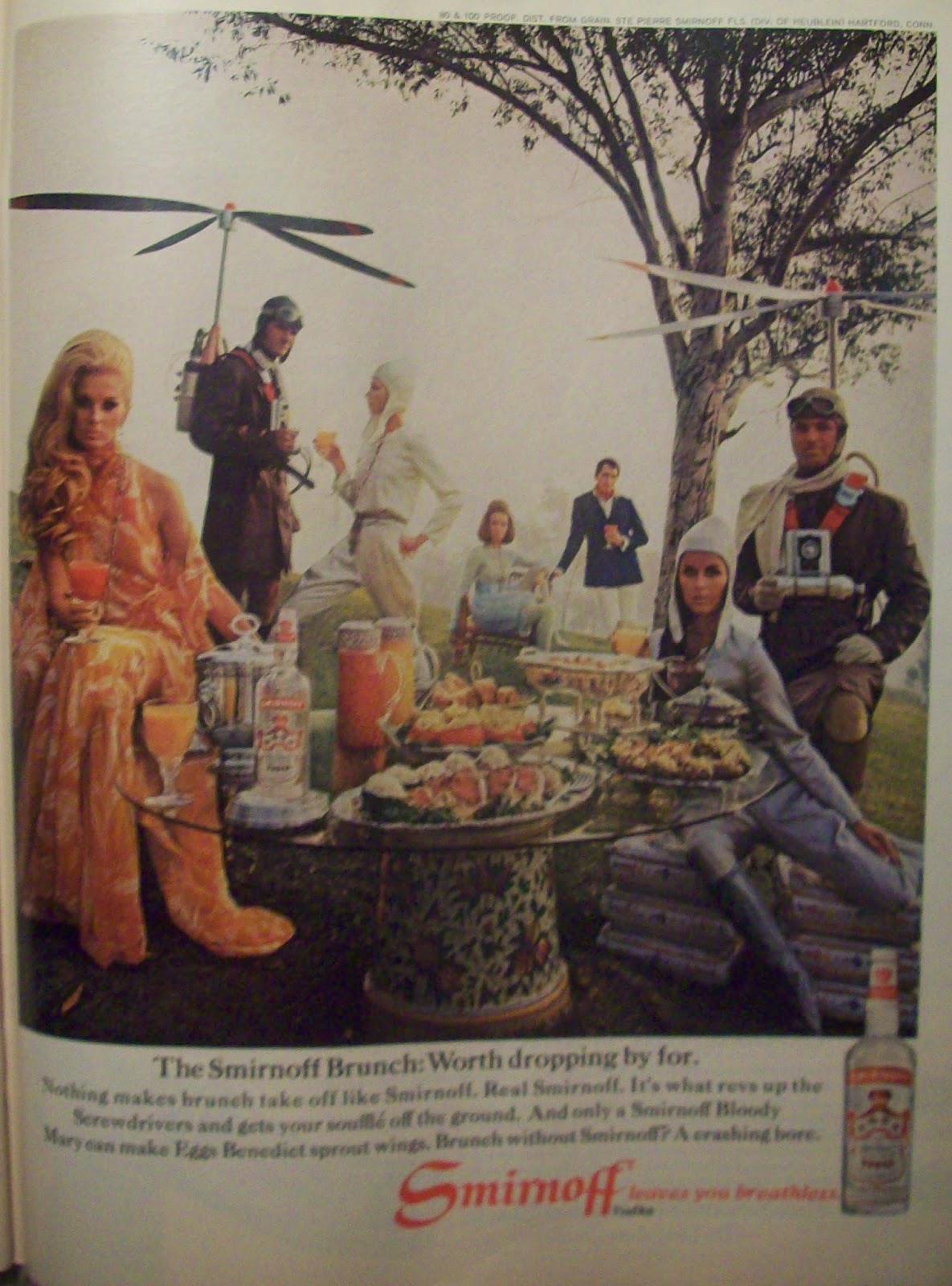
Lastly, here's some inspiration for a spring party, the pilots are optional.
I hope all of you enjoyed the images and look for more each Friday. I find vintage fashion editorials and ads very inspiring.
Last Wednesday I had the privilege of working with Thomas P. Woodward (http://tpwstudios.co/). This was not a typical photo shoot, it was a sort of day in the life shoot and it was a lot of fun. The photographer was so nice and easy to work with.
Jeremy and I went to Haddonfield for a date day and Mr. Woodward followed us with his camera. I really love that he shot on film, as you'll see in the photos film gives the photos a sense of warmth.
We spent a bit looking through some of the photographer's photos.
I love to walk especially in towns that have a great main street.
Jeremy and I outside the English Gardner Gift Shop. I always stop there when I go to Haddonfield to stock up on mushy peas and HP sauce.
Studying the shelves.
Trying to figure out what to buy, they have a huge selection.
From there we went to The British Chip shop, they have the best fish and chips in the area.
After lunch the shoot turned into, well, a typical photo shoot.
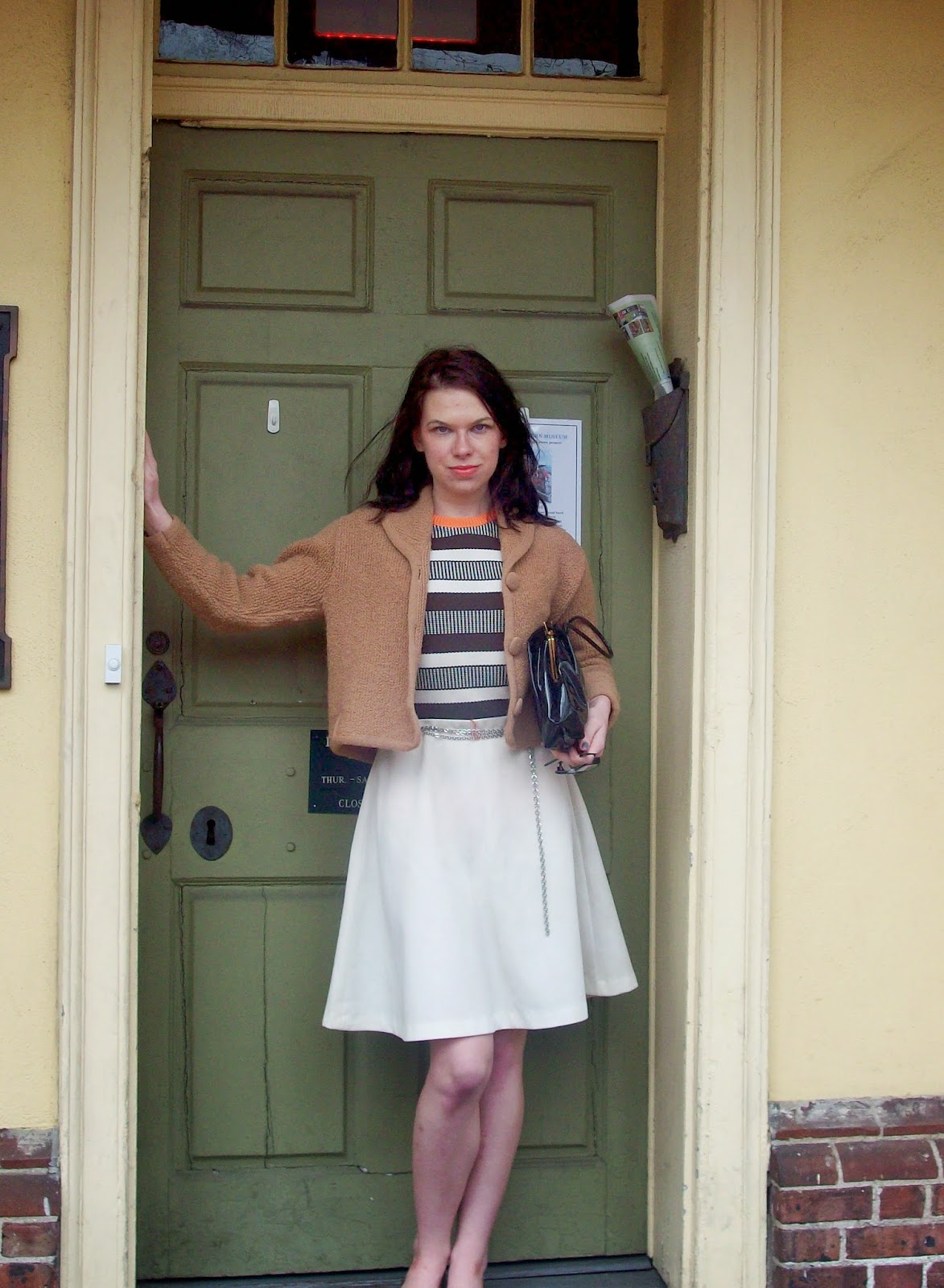
It's getting warm out and I was so glad I could wear my favorite 60s sun dress again, good bye winter! I am so impressed with how these photos turned out.
I have a guest blogger today for the weekly music post! My very talented and Debbie Harry look alike (she really is) friend Raine Laurent did an astounding with her post on 60s music. -Megan ----------------------------------------------------------------------------------------------------------------------------------
The great problem of the 1960s is that we approach them culturally rather than historically. We think hippies, we think woodstock, we think acid and orgies. The problem is that we're defining an entire decade by a stretch that really took off around 1967 with the Monterey Pop Festival (the real beginning of the so-called Summer of Love) and had a three or four year run before succumbing to the disillusionment and decadence of the early seventies, with the assasination of Martin Luther King and the Altamont Speedway Fiasco as grim bookends.
So then we wind up with more than half a decade to deal with. Most of us tend to just file the first half of the sixties in with the fifties, and assume that the whole world was Leave it to Beaver until LSD25 and Jimi Hendrix showed up to wake up young America. This is entirely false. The early sixties were still a different economy, a different culture, a different generation than the fifties. And along with all the other differences, it had a different record buying market and a different music industry to supply it.
The biggest shift to account for is that with the baby boom, the early sixties presented the first time that the primary consumers of records were teenagers and not adults. This is a shift that defines the music market to this day. Rock and roll was a more inclusive term between 1960 and 1964 - it included girl groups, surf rock, guitar bands, and retroactively encompassed the proto-rockers like Elvis, Chuck Berry, and the all-father himself, Little Richard. Rock and roll was the entire AM radio spectrum and the entire teenage world. What we're dealing with today is the "Hairspray" 60s, not the "Woodstock" 60s.
So knowing this, it's one of the great tragedies of pop music history that we tend to just classify the post-rockabilly, pre-British invasion years as some kind of lull. This fallacy is an accident, and an unfortunate one. Coming from our contemporary perspective, we tend to ony envision rock and roll as existing in the "rock band" paradigm - a self contained unit, usually built of an egomaniacal singer/lyricist and his crew of guitarists with excellent hair. To a teenager in 1963, rock and roll meant everything with a beat - that could be the Beach Boys or it could be the Chiffons.
And this music, along with the early rock frenzy of the aforementioned Elvis and Little Richard, is what informed the top notch songwriting of the Beatles and their British contemporaries. Let's just dispense with the ridiculous myth that rock and roll as we know it is built on the blues. Rock and roll as we know it is built on the RHYTHMS of the blues, which Buddy Holly adopted to add some oomph to much more traditional, old-fashioned pop song melodies.
Holly, probably the most important of the early rock progenitors, set the seedbed for clever poprock songwriting, guitar bands and instrumental novelties like the Tornadoes and the Ventures set the tones and techniques, and the girl groups and teen pop idols supplied the melodies and harmonic structure. Listen to the Beatles' entire early discography - those harmonies are pure brill building bubblegum, and half the songs are well-chosen covers from gems like the Shirelles and the Donays.
*Buddy Holly, It Doesn't matter anymore
* The Tornadoes, Telestar
DANCE DANCE DANCE
The real heroes of the early sixties pop world weren't rock bands or singers - they were writers, publishers, and producers. One of the many factors accounting for the abundant creativity in early 60s pop is the flexibility this model provided. Your singer isn't right for the song? You've got a whole stable of 'em. Wrote a song for a boy and the artist's record company doesn't have access to your publisher? Rewrite it for a girl. Hit factories like the Brill Building in New York and the now-mythical Motown weren't tied up with images or principles - they wanted hits, and so they relentlessly persued this goal by experimenting with every new trend and style as it came up.
Records were much bigger than performances in the early sixties, with teenage social life revolving much more around record hops than concerts. Consequently a lot of records were churned out with an unpretentious emphasis on danceability. Songwriters rushed to churn out catchy chord progressions in which they'd couch any outlandish ambulatory instruction that came to mind, all in hopes of birthing the next dance craze. Some of these were more successful than others but all got the job done and got the party moving. More obvious gems like The Mashed Potato (one of the few major records to come out of Philadelphia, which was generally overshadowed by the New York and Detroit music machines) and Shake a Tail Feather buried some really fantastic and sometimes bizarre novelties; some of them with interesting stories behind them. Novelties like The Monster Mash, of course, fall into this framework.Little Eva's well-known locomotion was crafted by songwriters Gerry Goffin and Carole King (more on them later) after seeing Bobby Darin's show at the Copa in early 1965. Supposedly husband/lyricist Gerry was intrigued by one particular song arrangement, and was told by wife/composer Carole that the sound that he was finding so mystifying was open fifths on saxophones - what we would now refer to as a power chord. Gerry was determined to turn out a hit using those chunky, blaring chords, and Carole crafted the music. They gave it to their babysitter and sometimes-demo-singer Eva Boyd (Little Eva) and the rest was history. Candy and the Kisses' "The 81" was a classic example of early 60s producers desperately trying to emulate the Motown sound in a bid to compete with Gordy's giant - in fact the backing track was a bit too similar to "In My Lonely Room", a smash that Holland-Dozier-Holland had concocted for Martha & The Vandellas, and Motown successfully sued.
There was no lawsuit surrounding the bizzarre "Peanut Duck", the bass riff of which would be nicked more than a decade lader by Punk Band Penetration for their "Don't Dictate". This is not the first or last time that 70s punk would be built on the foundation of 60s pop.
*Peanut Duck, Marsha Gee
*Don't Dictate, Penetration
*81, Candy and the Kisses
LITTLE SYMPHONIES FOR THE KIDDIES
If you poke around a lot of new indie rock, you've probably heard somebody use the term "Wall of Sound" at least a few thousand times, always careful not to damage your cred by admititng you had NO FUCKING CLUE WHAT IT MEANT. Well, mystery solved.
Before Phil Spector worked with the Ramones and then proved himself the most punk-rock producer of all by shooting a guy in the back, he was the enfante terrible of pop music. He designed his records to sound richer, fuller, more lush and delicious than anything else blaring out of a transistor radio. You really need mono sound to appreciate the effect.
The wall of sound revolves around gratuitous doubling - thickening a note by having two instruments play the same note in tandem. This is a common trick in jazz - popular unison voicings include having flutes and brass play the same note to blend the whispy, ethereal quality of reeds with the warm thickness of a trumpet or saax. Guitar and vibraphone together produce that bell-like, corny, "cocktail jazz" sound.
Well, Spector took the principle and amped it up full of PCP. Song had a guitar line? Well then it was going to take half a dozen guys all playing THE EXACT SAME THING, creating an incredible richness of sound. Four pianos, a pair of drum kits. Everything was doubled gratuitously by Phil and his regular session musicians (The Wrecking Crew, which included legendary drummer Hal Blaine and rare female guitar hero, Carol Kaye) resulting in the rush of teenage romanticism you can only get from the Ronettes, the Crystals, and other Spector specialties.
Spector owned the rights to the names of all the groups he produced, so his discography can be a labyrinth. The Crystals had three different lead singers, and some singles credited to them (He's Sure The Boy I Love, He's A Rebel) are actually backing vocalists The Blossoms.
Genius/Beach Boy/Nutjob Brian Wilson proclaimed Spector's production "Be My Baby" (Ronettes, 1964) to be "The most perfect pop song in existence". The song features all the rich doubling of pianos and brass, and of course a veritable choir of compressed backing vocals - supplied by Spector's go-to session singers, The Blossoms, Composer Ellie Greenwich, Spector protege/fanboy Sonny Bono, and his young wife Cherilyn Sarkasian. Another Ronettes perennial, "Baby I Love You", would be sumptiously covered by the Ramones on their "End of the Century", where the debt of punk rock to early sixties pop reached its apotheosis when the most famous punks of all were produced by Spector himself
More on "Be My Baby" - you've probably heard that distinctive drum tag on the song's opening quoted and imitated endlessly, or maybe even called the "Be My Baby" beat. What you're actually hearing is a cuban phenomena called the "Baion" beat. It's a standard 4/4, but having the emphasis on the ONE (two three) and the FOUR. The straight drumming of many of the British Invasion groups that so many Americans called the "Merseybeat" was nothing really new or distinctive - it was just that by the early sixties, Afro-Carribean rhythms had been so thoroughly integrated into American pop that we were stunned by something so, well, white! Other prominent examples of songs built around the Baione beat include Stand By Me (Leiber & Stoller for Ben E. King) and This Magic Moment, written by 30s-blues-singer-turned-60s-teen-pop-composer Doc Pomus and his teenage protege Mort Schuman, performed by The Drifters and by Jay and the Americans.
*Be My Baby, Ronettes
*Baby I Love You, The Ramones
LOCAL COLOR
One of the most rich and rewarding aspects of exploring the music of the early sixties is that the industry was so decentralized. Several major centers dominated the scene, all of them readily distinguishable. The lyrically naive and musically sophisticated teen pop of the New York Brill Building. The infectious Motown beat out of Detroit, which can be distinguished to this day by its eternal upbeat, every-note-accented-just-like-this. The slick, string-heavy records of Cameo-Parkway in Philadelphia presage the sparkling sheen of early disco. Record companies would compete with eachother and interact in interesting ways in the early 60s. Chess records, a company that specialized in more raw R&B and blues, which by the sixties were dated and somewhat passe to the teen audience, fell behind the other major music centers early in the sixties. "Rescue Me", by Fontella Bass, is often misattributed as a Motown single - the production was clearly trying to ape the Motown trademark. Listen to that bass chugging along.
Philly Pop Singer Bunny Sigler did a little known by lovely cover of the Shirelles "Will You Love Me Tomorrow", which trades the warm New York drums and guitars for bright piano and heavy string usage. The song has a common chord progression, and Sigler's recording of "Will You Love Me Tomorrow" actually uses the same backing track as Len Barry's familiar "One, Two Three (It's Elementary)"! Each region produced at least one luminary writing and producing team. New York had Phil Spector of course, but also Bobs Gaudio & Crewe (mostly known for great Four Seasons Hits like Ronnie and Dawn, their ear for rich harmonies and and a bright orchestral palette yielded some beautiful results for later Lesley Gore sessions), and Quincey Jones made a killing producing Teen Idol Lesley Gore. This was probably the first really prominent use of "double tracking", where Jones would "fatten" Gore's sound, by having her record the exact same vocal twice - it's not a harmony, but because sound waves are unique, each track has slight, almost imperceptible variations that combine to make a thicker, richer vocal track.
*Bunny Sigler, WIll You Love Me Tomorrow *Four Seasons, Ronnie *Lesley Gore, Treat Me Like A Lady
New York's Brill building also produced some of the most interesting songwriting teams of the era. The famous Burt Bacharach & Hal David duo, who produced songs known for their complex melodies and quirky rhythm shifts, Goffin and King, who could turn on a dime from writing teen pop for Bobby Vee (Go Away Little Girl), girl-group smashes (One Fine Day, The Chiffons, on which King played piano), or smooth Uptown Soul (Natural Woman for Aretha Franklin, So Much Love for Ben E. King). Jeff Barry and Ellie Greenwich specialized in supplying hits for girl groups like the Dixie Cups, Ronettes, and Shangri Las. Barry Mann and wife Cynthia Weil were some of the earliest to politicize pop music, with Mann's candy-sweet melodies supporting Weil's social commentaries on race and economic class (UpTown for the Crystals, We've Got To Get Out Of the Place for the Animals), Disillusionment with the American Dream (Magic Town, The Vogues) and Drug Addiction (Kicks, Paul Revere and the Raiders). Doc Pomus, a veteran blues singer in his youth, turned to writing teen pop with Mort Schuman, young enough to be his grandson.
The intergenerational duo cranke dout hits for Elvis (Marie's the name), and the standard "Save The Last Dance For Me" is more poignant when you know that Pomus was paralyzed, and wrote the lyric for his wife.*So Much Love, Ben E. King (Goffin/King) *Every Boy And Every Girl, The Chiffons (Barry/greenwich) *Make it easy on yourself, Dionne warwick (Bacharach/David) *Kicks, Paul revere and the raiders (Mann/Weil) *Save the last dance, The Drifters (Pomus/SChuman)
MOVIES FOR THE EARS
The early 60s were a less jaded time, and before music videos existed, songs had the freedom and the impetus to take a cinematic approach. Sound effects, narration, and other tricks were used to create a strong narrative - to create a sonic world and draw the listener into it. The Shangri Las most famously monopolized the approach and did it beautifully, mostly with the help of top-notch songsmiths Jeff Barry and Ellie Greenwich and always with erratic producer Shadow Morton on board. Songs like "Leader Of the Pack" and "I Can Never Go Home Anymore" painted vivid and soap-operatic portraits of teenage tragedy that were a treat then for the teenage heart, and are still deeply effective on the ear. The Shangri Las were the zenith of the phenomena known as the "Death Disk" (melodramatic pop records where the protagonists were iced by the end of the track), but other incidences were abundant.
The niche took off with Rey Petersen's hit "Tell Laura I Love Her", in which a boy frustrated by love proceeds to die in a drag race. In the UK, teen-pop phenom Twinkle, who came off something like a psychopathic Twiggy on record, was censured for her single "Terry" which made allusions to pre-marital sex and adultery. Sylvan's "We Don't Belong", a lush, symphonic pop single, was likewise banned for its overt tale of romantic suicide - the record was probably deeply influential on later generations of goth rockers. The lingering legacy of oldies like "Last Kiss" and "Teen Angel" only reinforce the eerie association of love and death, which must have been a thousand times more intense to a generation that had just had their sexuality sparked by Elvis Presley and Marilyn Monroe.
Maybe the most fascinating "sound plays" of 60s pop are the Shangri Las own "Past, Present, and Future" in which Mary Weiss narrates a story-probably-about-rape-trauma over an arrangement of Moonlight Sonata for electric guitar, piano, and strings, and "Nightmare" by the Whyte Boots. The latter is a great little do-it-yourself record, consisting mostly of just piano and drums, the "group" in all probability being just songwriters Pam Sawyer and Lori Burton overdubbed a couple times.
The record was publicized with real wanted posters and fake news articles, miming actual police blips indicating that the events in the song (a schoolyard brawl gone fatal) were factual, and even hinting that the non-existant members of the whyte boots were wanted for murder, and somehow found time to record a sleeper hit while on the lam.
*I Can never go home anymore, the Shangri Las
*We Don't Belong, Sylvan *Last Kiss, J. Frank Wilson and the Cavaliers *Nightmare, The whyte boots
FUN FACTS ABOUT GIRL GROUPS
The biggest boom in the pop music industry before the British invasion were girl groups. The harmonies, the adolescent heartbeat. Teenage romanticism at its finest. What makes this such a popular niche for music collectors is the astounding diversity of the field. Girl groups of the time were pretty much disposable - they were there to perform the songs that the writers gave them and the producers brought to life. This meant that great songwriters could try out different musical approaches on any given group, creating a huge breadth of styles.
The girl group bonanza began with Gerry Goffin and Carole King's "Will You Love Me Tomorrow" for the Shirelles, the lyrics of which were probably poignant for the couple who got married in college when Carole became pregnant. When the record hit number one,the race was on. Perhaps the songwriting/producing team most associated with the girl group boom were Phil Spector favorites Jeff Barry and Ellie Greenwich. Ellie, ever stage-frightened, could probably have become a pop star in her own right. You can hear her adding vocal fills (yeah, yeah, yeah, yeah, yeah!) at the end of "Chapel of Love", which the duo penned for the Dixie cups, and she does beautiful vocal work on her own debut single, produced by Shadow Morton, with whom she had frequently collaborated on material for the Shangri Las.
Motown had their own girl groups. Early star Mary Wells was shelved and groups like the Marvelettes, Martha and the Vandellas, and the No-Hit-Supremes (who had originally sung backup on Kim Weston's original version of "Stop In the Name of Love") were rushed to the forefront.
Beach Boy Brian Wilson had his own pet girl group, The Honeys, fronted by his wife Marilyn. The productions bear the inimitable beach boys stamp, but also owe more than a little to Wilson's idol, Phil Spector.
Fellow Spector-worshipper Sonny Bono, in a bid to emulate the Spector sound on a much lower budget, tried out a facsimile on his young Wife. This DIY approach must be admirable to garage-rockers even today.
As the marketplace of the later 60s geared more toward psychedelia and gimmick than plain ol' pop music, producers tried to keep up with the trends, with sometimes amusing results. Fairly innocuous popsters Reparata & The Delrons (Whenever a Teenager Cries, I'm Nobody's Baby Now) took a stab at psychedelia with their wonderful chestnut, "Saturday Night Didn't Happen".
*Ellie Greenwich, You Don't Know *The Honeys, He's a Doll *Kim Weston, Stop In The Name Of Love *Cher, Dream Baby *Reperata and the delrons, saturday night didn't happen
Two weeks ago I had the privilege to work with an amazing team of people to model dresses for the Etsy shop Sweet and Sour Vintage. Christopher Flanegan (www.christopherflanegan.com) was the photographer and Michelle Rivera of Truebutterfleyes Make up Artistry (https://www.facebook.com/truebutterfleyes) Michelle did a great job on my hair with an up do I could never manage and her make up skills stun me, she's really great. Christopher's photos were so polished which is especially important to show off the product. The dresses, I can't possibly say enough about the dresses.
This was the first dress I modeled and it would be perfect for anyone that has a spring event to go to. It can be found here
This would be so cute for a summer party and it can be found here
This dress was one of my favorites. It's from the 60s but has a 20s flair to it. I love the pattern of the sequins. It can be found here
If you've known me for awhile, you know I have a weakness for vintage gowns. This was a dream gown and it can be found here
I have my eye on this dress, it was one of my favorites for an everyday summer dress. The fabric is so soft and the colors and lace detail are so dreamy. It can be found here
I loved this wedding dress. The neck line really stood out and the long train is gorgeous. It can be found here
This dress fit so nicely, it hugged every curve and the lining was so soft. It can be found here
This is the best 50s wedding dress! There is beautiful detailing all over the dress and it can be found here
I was so nervous going to the shoot since it was the first time I'd ever modeled with a team this big. When I got there and met everyone all the nerves went away, they were all so great to work with. Sweet and Sour Vintage has tons of great dresses and accessories that are all top notch so please visit and treat yourself to something great.
I know, such an original title. Yesterday was the first official day of Spring and I don't care if it's too early I'm putting away all my winter clothes! As much as I love winter it felt way too long this year.
I love taking day trips when the weather is nice and yesterday Jeremy and I went to Haddonfield, NJ for the day. I love towns that have a nice main street with a lot of shops and walking space and Haddonfield has all of that. Every time we visit we eat at The British Chip Shop and get our fix of English snacks at The English Gardner Gift Shop. I adored England and their food when I went there many years ago. Sadly, I don't have the funds to go back right now but I can get good fish and chips and snacks close to home.
Jeremy brooding over a cup of Earl Grey.
His mood lifted when his scotch egg arrived.
I wasn't angry, just cold. This is a historic building in Haddonfield, the Indian King Tavern. The sweater has become a staple of my spring wardrobe. It was my Mommom's and it was the first gift my Poppop got her after they were married. He picked it out all by himself, he had great taste.
This was our tiny haul, we got the essentials. Ginger seemed to like the digestives.
Spring is such a lovely time of year. It feels like a renewal, I want to eat healthier, go outside and see new sights.
Some people find transitions into seasons difficult and I'm no exception. I find that sweaters are essential though. Spring is for floral patterns and bright colors but sometimes the weather doesn't want you to wear your bright floral sundress, spring can be strange.
What a week this has been. I've started booking photo shoots for 2014, this week and next week are filled but I've been having a blast. Spring is on the way and I'm so excited to shed my heavy winter clothes for my vintage sun dresses. Spring also means getting out of the house to do more things.
Last week, Jeremy and I went to our local library, the Franklin Township Library, to attend a Women of the Titanic seminar. The women dressed in Edwardian inspired outfits and recounted eyewitness accounts from notable women on the Titanic. Since the movie came out in 1997, I've been obsessed with the Titanic and I remember going to the library to scour the internet for information about the ship and photos of edwardian dress.
This was a christening dress, the longer the dress for the baby the wealthier the family. Look at the detail!
This was a party dress for a girl. I love the belt.
This was my favorite, it's a walking dress from 1910
I have to write this, it's a topic that's been brewing in my mind for some time now and I just have to get it out before I make my own sobbing youtube video. Leave Marilyn Monroe alone!
This photo has been floating around the internet for some time and every time some one posts it I want to reach through the screen and shake them. It's a lovely sentiment but Marilyn Monroe never said it, there was no such size as a size 0 during her life. In fact that type of sizing didn't appear until the 80s
It's frustrating that so many people keep these quotes in constant circulation, there is no push to check for their validity. If you do any research on sizing you will soon realize that type of sizing didn't appear until the 80s.
Marilyn has now become this sort of "stock" image especially for teenage girls. They've misattributed so many quotes to her and believe so many false things about her, like that she was "plus sized" by modern standards.
Marilyn Monroe was anything but plus sized. Her measurements were approximately 35,22,35. Although her weight fluctuated throughout her career she was not plus sized.
I implore you to to do your research if you love Marilyn Monroe. Delve below the surface, you'll find out that she was a very fascinating woman.